Thursday, 14 November 2013

How to identify genuine French furniture


Whilst authentic French furniture is very distinctive, reproduction pieces have flooded the UK market in recent years. The thirst for all things French has led to a flurry of mass produced 'French' beds, armoires and buffets. These pieces, which aim to capture the essence of French style, are often poorly made and tend to retail at higher prices than originals. 

Since starting our business in November 2011 we have invested a lot of time in gaining knowledge about the items we sell. French furniture is unique in its quality, craftsmanship and style. 

Detail from an authentic Demi Corbeille French Bed 

Some sellers may unwittingly sell reproduction pieces believing them to be genuine, however, for the buyer the difference is huge. Authentic French furniture is a great investment. Genuine pieces will always hold their value, and more often than not, the value of pieces will increase. Before making any purchase make sure you ask the following questions: 

1. What Type Of Wood Is It?


Most vintage and antique French furniture is made of oak, chestnut or cherry wood. You will occasionally find pine pieces but they are not as common as in British furniture of the same era. If a piece is stated as being pine, make sure you double check all the other signs outlined below, particularly if the item is painted. Any piece that has a suspiciously 'orange' coloured pine interior should raise concerns!

2. What does it look like inside?


Interior of a genuine painted pine French armoire

Looking inside an armoire, vitrine, buffet or chevet can tell you a great deal about its age and provenance. This is especially important if the item has been painted. Sadly there are some unscrupulous sellers out there who will try and pass off a cheap pine wardrobe as a French armoire.


All genuine French furniture will show its age inside and out. Wood will often have an aged colour/appearance and quirks. Genuine provincial pieces were hand made and you can see the craftsmanship. Later 'revival' pieces, whilst newer, will still have signs of wear and use. 

Perhaps one of the most common tell tale signs is evidence of previous woodworm infection. It's rare to find a piece of genuine French furniture without a single worm hole!

3. What do the handles look like?


Authentic antique French armoires will usually have beautiful adornments, such as brass escutcheons and detailed handles. 

Dealers who specialise in British Edwardian and Victorian furniture will often be able to easily age a piece by the handles. This is also true of French furniture. British and French handles are uniquely different. 


  A handle from a Henri II style French armoire C. 1890 to 1910. 

 A handle from a French Louis revival armoire C. 1970

4. What do the door hinges look like?


 Detail of door hinges from two provincial French  armoires C. 1850 to 1890


Probably the biggest tell tale sign of all! French furniture does not have screw in hinges, as British furniture does. Older French armoires and buffets will have beautiful brass door hinges which simply slide onto the outside frame. Fantastic craftsmanship which doesn't require a screwdriver! 

More modern revival pieces will have no visible hinges at all. Instead they sit on 'pivots' which slot into the base and which allow them to open and close. Like older armoire and buffet doors they simply lift out of the frame with no screws involved.

Does it come apart? 

Nearly all French armoires are 'knockdown', this phrase means they are designed to knock down into smaller, more manageable pieces, making them easy to transport. Some genuine sellers may not know whether a piece knocks down but you can tell by looking at the inside. Older, provincial and L0uis Philippe style armoires will be held together with small wooden pegs. Use a torch to look at the areas where the joints meet, if small round peg ends are visible the item is genuine. 

French revival armoires are assembled using large bolt screws. These should be clearly visible where the cornice meets the sides, and at the base. 

If the armoire has no signs of being knockdown ask the seller for more clarification on the age and provenance of the piece.


The Author

Ali Stokes is the owner of the UK based online boutique Dazzle Vintage Furniture. The website specialises in selling authentic French furniture and accessories which have been imported from France. 


Wednesday, 6 November 2013

Buying Antique and Vintage Furniture: An Antique Dealer's Guide 2


This is the second in a short series where we'll be showing you the pros and cons of buying vintage and antique furniture. This time we'll be focusing on buying from online auction sites, probably the riskiest place in terms of knowing what you're getting, but the best place in terms of variety and price. 

Online Auction Sites

Online auction sites have transformed both the buying and selling experience in so many ways. On the positive side it's now incredibly easy for anyone to set up their own business. Without the need for a bricks and mortar shop, you can start small with very little finance and grow your business in your own time. 

But is this new selling culture also good for the consumer? As we discussed in our previous post, when you visit an antiques shop you should expect the dealer to have an indepth knowledge of the items they are selling and to be able to date pieces correctly and not mislead. If a person with very little knowledge of antique furniture opened a physical shop their inexperience would quickly show, and just as quickly, their sales would falter. 

It's true that there are some great bargains to be had on online auction sites, but beware, not everything is what it claims to be. Antique and vintage furniture, as well as being practical and beautiful, can serve as a great investment. It's important therefore to know that what you are buying is genuine.  


Buying From Private Sellers

Obviously not everyone selling on an online site is a dealer, they are many who simply want to de-clutter or update their decor. The great thing about buying from private sellers is that they don't tend to make grand claims about their items. Indeed, their lack of knowledge can sometimes work to your advantage. I routinely see people mis-describing furniture, usually crediting it as being more modern or less inherently valuable than it actually is. 

You can of course ask the seller questions and ask for more indepth photos. But you should probably be wary of bidding too high. With private sellers you can't return an item, so if you make a mistake that's simply tough. Although you can always relist the item and get your money back that way if you are so inclined. 

When it comes to buying from private sellers there are really only 2 rules: 

1. If it is decorative - buy it because you love it.
2. If it is functional - make sure you educate yourself about the item so that you know the pertinent questions to ask the seller regarding the condition.  

These 2 rules also apply to buying from business sellers, however, be warned - this is more of a minefield! 

Business Sellers

Of course there are great business sellers out there selling on auction sites. We are constantly being told about the death of the high street and high business rates and rents mean that many dealers now have 'virtual shops'. 

It's common for dealers, such as ourselves, to sell from a website but to also have listings on an auction site. It's a great way of showcasing our items to a large audience. Of course the feedback system is there to help buyers make informed decisions, but what other things should you consider? 

1. Always make sure you read item descriptions carefully - sellers will often list items as 'French', but then in the description describe the item as 'french style'. You'll also see 'antique style' and 'vintage style'. This means that they aren't genuine and are probably new items made to look old. 

2. Also be careful of sellers misinterpreting or mis-describing the age of pieces. This might be a genuine mistake on their part but any dealer worth their salt should know the difference between Georgian, Victorian and Art Deco furniture. I routinely see items listed as Georgian, and in the case of French furniture, Louis XVI. If genuine these pieces would be highly collectible and command serious prices. If in doubt, email the seller and ask for clarification on the age of the item. Georgian furniture covers the reign of George I (1714-1727) through to the death of George IV (1830). Genuine Louis XVI pieces are extremely rare on the UK market and date from the 1700s.  

3. If the price seems too good to be true then it probably is. So you've found a 'Georgian' bureau for £150? If it was genuine no dealer could buy it for that, let alone make a profit. Any dealer selling it at that price either knows it's not genuine, but assumes you won't, or knows nothing about the items they're selling. The same is true of genuine French furniture. Because of it's popularity and the dearth of pieces on the UK market it commands a certain price. Often sellers with cheaper furniture will describe it as French in order to aid it's saleability  Again, if in doubt, email the seller and ask to know the date and the origin of the piece. 


The Author

Ali Stokes is the owner of the UK based online boutique Dazzle Vintage Furniture. The website specialises in selling authentic French furniture and accessories which have been imported from France. 

Wednesday, 24 July 2013

Buying Vintage and Antique Furniture: An Antique Dealer's Guide


This is the first in a short series where we'll be showing you the pros and cons of buying vintage and antique furniture. We'll be sharing the dealer secrets of how to get the lowest price, where to buy from and, offering tips on what to avoid!  

In this first part we'll be focusing on buying directly from dealers and live antique auctions. 

1. Antique Shops


If you have no knowledge at all about antique or vintage furniture and want to invest your money in pieces that will hold their value or increase, then buying directly from a dealer is the safest bet. Antique shops will always be the most expensive option, but if the dealer is reputable, they will also be the safest. 

A dealer lives or dies on their reputation, selling pieces that are faulty or mis-described is counter productive. If you can chose a dealer who is well established. Survival says a great deal about their honesty and the quality of the pieces they sell. 

Any reputable dealer will be knowledgeable about their stock and usually specialise in a particular era or style. They should be able to tell you about the age of the piece, the materials it's made from and sometimes its provenance (that is - where it came from). 


Don't be afraid to haggle - some dealers will flatly refuse, others will be accommodating. If you are buying more than one item you can almost guarantee a discount. Make sure you ask about delivery fees as well, not all dealers run their own van and many will use costly couriers. You may find that your bill is far larger than you expected. Feel free to find your own man and a van, as long as he can fit in with the dealer and not try and collect outside of opening hours. 

One important thing to note about buying from shops is the difference between 'antique' and 'vintage'. Most people classify antique items as being over 100 years old. Traditionally an antiques shop will sell higher end pieces from the Georgian and Victorian eras. In recent years vintage has become seriously trendy and there are shops popping up all over the high street selling painted furniture. There are some great bargains to be had here, especially if you are queasy about painting pieces yourself. Just remember however, that most painted furniture is sold as a decorative item, unlike higher end pieces, they won't necessarily hold their value or in fact, have any inherent value. The trend for upcycling is really about saving unloved pieces that would otherwise go to furniture heaven. 

Be wary of sellers in these shops marking painted items as French, particularly if they are claiming it is the original paint. French vintage furniture is more desirable than its British equivalent and for that reason it has, and probably will always have, a greater inherent value. Pieces with original paint are extremely rare. Later in this series we will be showing you how to tell the difference between a real piece of french furniture and a British impostor. 

2. Antique Fairs


If you know your stuff antiques fairs can be a great place to pick up bargains, but beware, they are less regulated. Anyone can hire a stall and start selling antiques. As with antique shops ask lots of questions. Many reputable dealers do attend antique fairs and you should be able to tell the difference between the professional sellers and the less so. 

For vintage items, where the age and condition of the item is less important, fairs are great places. You can handle items in a way that would be frowned upon in a shop and best of all, haggling is expected, sometimes actively encouraged. 

The big draw back with fairs is that you as a consumer are not protected if you buy a faulty or mis-described piece. I recently attended an antiques fair where a stall was selling a pair of candle sconces which were labelled as being French C. 1850. They were marked at £185. I asked the dealer what her best price was. She firmly told me she couldn't move on the price and that £185 was actually cheap for what they were. She then proceeded to spin an elaborate story about how they had been found in a French chateau. As a dealer in French items I knew on sight that they weren't French. They were British piano sconces dating from no earlier than 1910 and worth about £30. You can pick them up on Ebay for even less. 

The moral is be VERY careful and don't always believe what you're told. If you have any hesitation don't buy, as you may never see that dealer at another fair again and getting your money back will be almost impossible. These dealers rely on passing trade not recommendations. Only buy pieces because you love them and want to live with them no matter what they are. 

3. Live Auctions


By far the best place to pick up antique bargains is at your local auction house. Auctioneers have a great knowledge of items and can provide dates and detailed condition reports. If you are unsure do talk to the auctioneer, live auctions are 'buyer beware' sales, if you bid on something that turns out to be broken you can't return it. Make sure you visit the auction preview and examine the item in as much detail as possible. 

Usually catalogues will include an estimate price, although bare in mind this is a guide only. If two people are determined to get one item the bidding can go sky high.  

The secret to succeeding at live auctions is to give yourself a maximum bid amount (remember the auctioneer will add a buyers premium as well, usually about 20%). Whatever you do DO NOT go above your set amount. Auctions move extremely fast and it's easy to lose track of whether you are the leading bidder. With the added adrenalin it's also very easy to get carried away and end up paying far more than you wanted to for an item. 

To get the lowest price possible steal some tips from the dealers. Usually the auctioneer will offer a starting bid. In a room full of dealers no one will take this first bid, in my experience it's a mistake private buyers always make. With no hands raised the auctioneer will go lower and lower until someone jumps in. This forces the starting price to be much lower giving you more scope to get the price you want. If the bidding starts high it will inevitably end high. 

As a dealer I would often withdraw from bidding early if I was up against a private buyer. In a regular auction room most dealers will know each other and have an idea of each others spending power. They will also have an unwritten code about not bidding on items that another dealer specialises in. When faced with private buyers the game changes as the dealer has no idea of that persons spending power. If you bid with confidence and a look of steely determination you can often deter them from staying in the game. Remember that dealers need to make a profit, they want to get items as cheaply as possible and many will set their maximum bid very low. This means that despite having less experience, you will have the upper hand. Just make sure you're bidding on the right lot! In my early days as a dealer I accidentally bought a nasty knackered bureau when I thought I was bidding on a fantastic Victorian compactum. The golden rule: pay attention, you can't turn the clock back once the hammer goes down!


NEXT TIME: The pros and cons of buying from online auction sites and how to tell the difference between a real piece of French furniture and a fake.  


The Author

Ali Stokes is the owner of the UK based online boutique Dazzle Vintage Furniture. The website specialises in selling authentic French furniture and accessories which have been imported from France. 


Monday, 14 January 2013

French Chandeliers and Vintage Lighting


Dazzle Vintage Furniture is an online boutique specialising in authentic French furniture and lighting. We stock a range of original French chandeliers, wall sconces and vintage lights. Since beginning to import French furniture in 2011 we have learnt a great deal about these beautiful pieces, and what makes them special. Here we hope to share some of this passion and knowledge, including a guide on what to look for, and more importantly, what to avoid, when buying vintage lighting.


Why Buy Vintage Lighting?

Modern reproduction pieces can never match the quality and charm of beautifully made, solidly constructed French pieces. Vintage chandeliers have exquisite detail making them appear as beautiful unlit on a sunny day as they do lit up at night. These pieces are weighty and will last another 100 years as long as they are looked after. They can also be heirlooms, retaining their value where modern pieces depreciate soon after purchase. 

Whether you have a modern house or a period property, a vintage chandelier can add a shimmer of French glamour and decadence to any styled room, creating a focal point and making the smallest of rooms look grand. 

Different Types of Vintage Lighting

Continental vintage lighting comes in many shapes and forms. There are lights to suit any room of the house. For boudoir glamour nothing beats a crystal chandelier. These beautiful and delicate pieces have stunning detail and produce a gorgeous shimmering warm glow. 

Always check that the crystals are all intact. Spares can be bought but they are often expensive. Any reputable dealer will mention any loss of drops. 


Detail from French Vintage Crystal Chandelier


Heavy brass and bronze chandeliers, usually with between 3 and 6 candle holders, are perfect for tall hallways, dining rooms and sitting rooms. These give bright, gleaming light and add a feeling of height to smaller rooms.

Always check the condition of the candle holders before purchasing. These are the most fragile parts on a vintage chandelier and frequently get cracked or broken. On older chandeliers slightly cracked and discoloured candle holders add charm and a sense of age to the piece. Be careful to look for sellers who replace the original holders with cheap modern ones sometimes made of cardboard. 


Vintage French Brass 3 Arm Chandelier 


Detail from Vintage French 5 Arm Chandelier 


Wall sconces are perfect for adding subtle light to living rooms and halls. These tend to suit older houses with period style rather than modernist homes. Check the lights have been rewired for modern fittings. Many sellers will sell these as 'found', often for use as candle holders. If you want to use them as lights check that they have been rewired to meet UK safety standards.


Set of French Vintage Wall Sconces  


Detail of wiring in a rewired set of French Vintage Wall Sconces
  

It's a little known fact that continental wiring differs greatly to British. Many vintage French and Italian chandeliers will simply not work in the UK until they are rewired, and this is not a simple task. Always make sure you buy from a reputable seller who clearly states whether or not the lighting is sold as a decorative item, or as a fully working piece. Vintage French lighting in its original state will not be earthed. Any reputable dealer will rewire items that are sold as lighting and provide safety certification on request. 

All the vintage lighting that we sell, unless stated otherwise, is rewired and reconditioned so that it is sold ready to use without fuss or extra expense.


Detail of wiring in a rewired French Vintage Chandelier 


Detail of wiring in a rewired French Vintage Chandelier 

French lantern lights are perfect for hallways, giving a wonderful clean bright light reminiscent of Victorian street lighting.


French Vintage Lantern Light 

As well as heavy brass chandeliers and sconces the French are known for producing Toleware lighting. Usually in the shape of flowers and leaves, these pretty and delicate pieces are perfect for bedrooms and provide something for those whose tastes are quirky and who cherish things a little different.


Vintage French Toleware Chandelier  


Who are we?

Dazzle Vintage Furniture is an online boutique specialising in authentic French furniture, lighting and accessories. We stock vintage armoires, French buffets, French vintage beds, antique mirrors and chandeliers. All our French furniture and lighting is original, vintage and imported directly from France.


Detail from Italian Vintage Chandelier


Italian Vintage Glass Crystal Chandelier


Tuesday, 27 November 2012

French Furniture Styles


As an online boutique specialising in authentic French furniture we stock a wide range of original pieces. Since beginning to import French furniture in 2011 we have learnt a great deal about these beautiful items, and what makes them special. We are passionate ambassadors for real French furniture (over cheaply made reproductions) and here we hope to share some of this passion and knowledge.

Below is a very brief guide to the wonderful world of French furniture, covering some of the the various items and styles a buyer is most likely to encounter. 


Common Items of French Furniture

Buffet - a sideboard or dresser. French buffets are often extremely large. Single buffets tend to be very long with numerous drawers and cupboards. Two part buffets reassemble dressers and are called Buffet et Deux Corps. Often the upper cupboard will have glazed doors.

Armoire - often used as a sweeping term for a wardrobe, it actually denotes a two door cupboard. Authentic French armoires were made to house shelves and were found in just about every room of the house. They served as larder cupboards, linen presses and as storage for china and cutlery.

Commode - a French chest of drawers. The term commode means "comfortable" or "convenient". Introduced in the 17th century, these pieces are often very elaborate, with marble tops, gilding and painted decoration.

Bonnetiere - a narrow, tall single door French cupboard originally made to store bonnets.

Table de Chevet - a bedside cabinet/table.

French Painted Marble Top Table de Chevet

French Furniture Styles

As in British furniture each era generated a wealth of styles. Confusingly, unlike Victorian and Edwardian furniture, styles named after royalty don't necessarily date to individual reigns. Many overlap and have sub-divisions of styles, being sometimes more of a subtle evolution, than a revolution.

Louis - Probably the most recognisable, influencing modern British reproduction 'French style furniture'. Original Louis XV pieces date from around 1730 onwards, evolving into the Louis XVI style, beginning around 1760. These two styles of furniture often get grouped together under the simple umbrella of 'Louis'. Notable features include curved lines, cabriole feet and decorative motifs dominated by shell designs, birds and floral carvings.

Painted Louis Style Vintage Armoire


Henri II (1860-1900) - Also known as French Renaissance, Henri II furniture is notable for its size and solidity. Pieces tend to be huge and rectangular in composition, with heavy carving, dark wood and large bun feet. Armoires are notable for their often elaborate cornices with large finials and crests, and show a strong Italian influence in their carving and design. Mirrors and beds tend to be very ornate, with carved pillars and finials. Armoires have either solid wooden doors or glass mirror doors.

  Henri II Style Armoire

 
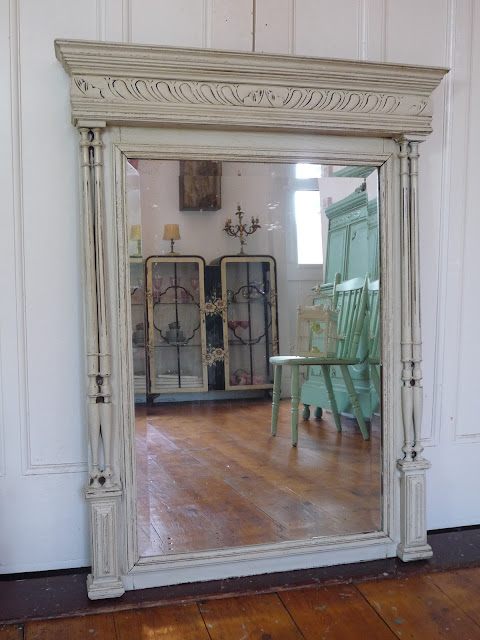
 Painted Henri II Style Mirror

Provincial/Country - Provincial furniture was made in the provinces, as opposed to the furniture made for the King and court in Paris. Court fashions often took a while to filter to the provinces, and as result French provincial furniture displays an array of overlapping styles. Most notable are pieces showing the influence of the countryside - woven rush chairs and simplified carving representing wheat sheaves and foliage. Pieces tend to be highly rustic in finish and style but beautifully made. Most notable are the huge armoires which are fully knockdown and held together with chunky, hand made wooden pegs.

Original Chestnut Provincial French Armoire

Breton - Breton furniture is highly distinctive. Often made of heavy, dark oak and highly carved, with fretwork a notable feature. Squares and rectangles predominate, with intensely carved human figures and faces, animals, plants and ships wheels. Maritime motifs also predominate, reflecting Brittany's close association with the sea. Armoires are often shorter than other styles and many come as bedroom sets with matching beds and pot cupboards.

Detail from Painted Breton Bed

Louis Philippe - Louis Philippe style French furniture emulates the furniture popular during the reign of Louis Philippe I (1830-1848). Known as the 'Citizen King', he was a popular figurehead, leading a less than lavish lifestyle. Similarly the furniture named after him is beautiful for its simplicity. These pieces epitomise elegance and tend to be less ornate and more refined than other styles. Armoires are recognisable by their wide cornice, tall body and raised feet. Like the Louis style, these are much imitated, but originals tend to be beautifully constructed and cleverly fully knockdown.

Louis Philippe Style Armoire

Art Deco (1920s - 1940s) - The Art Deco movement first appeared in France during the 1920s. Reflecting a new modern era, Deco embraced geometric forms such as rectangles and zig zags. French Deco furniture is often quite chunky, with chunky feet, geometric lines but also strong floral motifs that are far bolder and heavier than previously seen.

Who are we?

Dazzle Vintage Furniture is an online boutique specialising in authentic French furniture, lighting and accessories. We stock vintage armoires, French buffets, French vintage beds, antique mirrors and chandeliers. All our French furniture is original, vintage and imported directly from France.

Tuesday, 20 November 2012

French Armoires

As an online boutique specialising in authentic French furniture we stock a wide range of original French armoires. Since beginning to import French furniture in 2011 we have learnt a great deal about these beautiful pieces, and what makes them special. We are passionate ambassadors for real French furniture (over cheaply made reproductions) and here we hope to share some of this passion and knowledge.


Exterior of Painted Henri II Style Vintage French Armoire


What is an Armoire? 

There tends to be a general misconception that the term 'armoire' is simply the French word for 'wardrobe'. In fact there is no literal translation of the word armoire into English as no such piece of furniture exists in English culture. The closest translation would be 'French cupboard', so the many UK furniture dealers you find advertising wardrobes as armoires are really being quite deceitful! It's known that tagging items as 'French' tends to make them more desirable, however, to be a REAL armoire an item must be:

1. French (that is, actually made in France)

2. Have once had, or still have, shelves


Interior of Painted Pine Louis Philippe French Armoire with original shelves

In their essence, French armoires are really large multifunctional cupboards. If you peak through the windows of many traditional French homes you'll see huge armoires inhabiting dining rooms, kitchens, hallways and bedrooms. Basically they serve a use in every room of the house, which is why they are such terrific pieces to own. In the kitchen they can be used as larder cupboards, in dining rooms they serve as great storage for plates and serving bowls and in bedrooms and on landings they serve to store clothes, bedding and other linens.

What are the different types of French armoire? 

Under the umbrella term armoire many styles exist. These mostly represent different eras and different areas of production. Perhaps the most familiar style to British buyers is the often reproduced 'Louis' style.

'Louis' Style French Armoires: These pieces are made to emulate the style and opulence of the French court of Louis XVI and his queen Marie Antoinette. They usually have double mirror doors, stand on decorative scrolled feet and have a domed shaped cornice, often with a large crest. This style probably epitomises what most people think of when they visualise French furniture, in particular, armoires. However, it isn't that typical of true French furniture and much of what is seen on the market today is mass produced in countries such as China and India for the UK and American market. Any real armoires surviving from Louis' reign are now worth a small fortune. The Louis armoires that we find in France, such as the two pictured below, date from the early to mid 20th century and are French 'revivial' pieces, made to emulate the original 18th century styles. These vintage pieces tend to be of far higher quality than the new ones being produced today.


Small Louis Style French Armoire


Large Louis Style French Armoire

Louis Philippe Style French Armoires: In the style of furniture popular during the reign of Louis Philippe I (1830-1848). Known as the 'Citizen King', Louis Philippe was a popular figurehead. Noted for not leading the usually lavish lifestyle of a royal, furniture named after him is beautiful for its simplicity. These pieces epitomise elegance and tend to be less ornate and more refined than other styles. Armoires are recognisable by their wide cornice, tall body and raised feet. Like the Louis style, these are much imitated, but originals tend to be beautifully constructed and cleverly fully knockdown.


Louis Philippe Style French Armoire

Interior of a large provincial French armoire

Provincial French Armoires: Provincial furniture was made in the provinces, as opposed to the furniture made for the King and court in Paris. Court fashions often took a while to filter to the provinces, and as result French provincial furniture displays an array of overlapping styles. Most notable are pieces showing the influence of the countryside, with simplified carving representing wheat sheaves and foliage. Provincial French furniture is often highly rustic in finish and style but beautifully made. Large armoires such as the one pictured below are fully knockdown and held together with chunky, hand made wooden pegs.

Original Provinicial Armoire

Art Deco French Armoires: The Art Deco movement first appeared in France during the 1920s. Reflecting a new modern era, Deco embraced geometric forms such as rectangles and zig zags. French Deco furniture is often quite chunky, with chunky feet, geometric lines but also strong floral motifs that are far bolder and heavier than previously seen. 

Painted Art Deco Armoire

Henri II Style French Armoires: Also known as French Renaissance, Henri II furniture is notable for its size and solidity. Armoires tend to be huge and rectangular in composition, with heavy carving, dark wood and large bun feet. They are notable for their often elaborate cornices with large finials and crests, and show a strong Italian influence in their carving and design. Armoires have either solid wooden doors, such as the piece pictured below, or glass mirror doors.

Henri II Style Armoire

Breton French Armoires: Breton furniture is highly distinctive. Often made of heavy, dark oak and highly carved, with fretwork a notable feature. Squares and rectangles predominate, with intensely carved human figures and faces, animals, plants and ships wheels. Maritime motifs predominate, reflecting Brittany's close association with the sea. Armoires are often shorter than other styles and many come as bedroom sets with matching beds and pot cupboards. 

Why should I buy an original French Armoire rather than a modern reproduction piece?

When there are so many reproduction armoires on the market it's tempting to ask why buy originals? Possibly one of the most unrecognised points is that often the real thing is far cheaper! Many repro armoires retail at far higher prices than antique and vintage ones, despite often being quite poorly made. French armoires of all styles tend to exhibit exceptional craftsmanship. As well as being beautiful and practical, they will never devalue (unless you ill treat them!). French furniture never goes out of vogue and purchasing an authentic armoire is a solid investment as well as a beautiful storage solution. 

How can I tell a real French armoire from a reproduction one? 

As with most antique and vintage furniture we can age pieces according to their construction and their apparels. Look at feet, hinges, handles, keys and locks and such give aways as depth and wood patternation. Most authentic French armoires will fully knockdown, that is, disassemble completely. Antique French armoires, pre-1900 will often knockdown into very small constituent parts are held together using a mix of wooden pegs and inbuilt large screws. Very old armoires will have pegs only. More modern armoires (post 1930) will usually be held together with large removable screws and will knockdown into less pieces, often with intact bases, cornices, sides and back panels.

Who are we?

Dazzle Vintage Furniture is an online boutique specialising in authentic French furniture, lighting and accessories. We stock vintage French armoires, French buffets, French vintage beds, antique mirrors and chandeliers. All our French furniture is original, vintage and imported directly from France.

http://www.dazzlevintagefurniture.com